The global oil and gas drilling services market continues to grow in 2026, with Rotary Steerable Systems (RSS) and Measurement While Drilling (MWD) technologies advancing rapidly, placing higher demands on downhole inertial sensor testing accuracy.
I. Industry Background: Steady Growth in Oil & Gas Drilling Market Drives Testing Demand
Global oil and gas drilling activity remains robust in 2026. According to industry data, the oil and gas wells drilling services market grew from $51.76 billion in 2025 to $53.42 billion in 2026, and is projected to reach $61.38 billion by 2030, at a CAGR of 3.5%-. The global oil and gas upstream activities market is expected to grow from $4.84 trillion in 2025 to $5.11 trillion in 2026, at a CAGR of 5.5%-.
In directional drilling, the global directional drilling services market was valued at $13.87 billion in 2025 and is projected to reach $25.07 billion by 2034, at a CAGR of 6.65%-. Meanwhile, the global MWD system market was valued at $4.13 billion in 2025 and is forecast to reach $6.39 billion by 2032, at a CAGR of 6.4%-.
II. Four Key Technology Trends in Drilling for 2026
1. AI and Automation Drilling Accelerate Deployment
In 2026, artificial intelligence applications in drilling are moving from concept to practical deployment. The IADC/SPE 2026 conference noted that operators across the drilling value chain are seeking greater efficiency, with AI and its automation applications offering a path to a new era of energy efficiency-. Corva and Phoenix Global Resources signed an agreement to integrate predictive analytics capabilities with automated drilling systems in unconventional operations-. Rockwell Automation's report also indicates that AI, IoT, and cybersecurity are reshaping operations from exploration to refinement-.
2. Rotary Steerable System (RSS) Market Continues to Expand
As a core technology in directional drilling, the global RSS market was valued at $5.5 billion in 2024 and is projected to reach $6.9 billion by 2030-. Global rotary steerable tool sales reached $1.95 billion in 2025 and are expected to reach $2.62 billion by 2032-. Industry trends show that advanced technologies such as self-steering RSS and remote directional execution are improving well placement accuracy and drilling efficiency-.
3. High-Temperature MEMS Sensor Technology Breakthroughs
Downhole extreme environments impose high demands on sensor high-temperature tolerance. TDK recently expanded its high-temperature MEMS accelerometer portfolio, launching an accelerometer for drilling measurement applications up to +175°C with a lifetime exceeding 1,000 hours at +175°C, paving the way for a new generation of MWD tools to meet the accuracy and productivity requirements of complex and unconventional drilling operations-. Additionally, high-temperature MEMS IMUs specifically designed for logging and drilling (e.g., ER-MIMU-09C) achieved breakthroughs in 2026, addressing downhole extreme environment sensing challenges with high-temperature tolerance, high precision, and compact size-.
4. Geothermal Drilling Market Grows Rapidly
The global geothermal drilling market was valued at $10.61 billion in 2025 and is projected to reach $11.13 billion in 2026, reaching $14.77 billion by 2032 at a CAGR of 4.83%-. Global decarbonization mandates and baseload power requirements are driving growth in the geothermal drilling market-. Meanwhile, the global Enhanced Geothermal Systems (EGS) market was valued at $3.20 billion in 2025 and is projected to reach $4.92 billion by 2032 at a CAGR of 6.35%-.
III. Product Solution: BE-INS3-26B07 High Precision Three Axis Rate Table
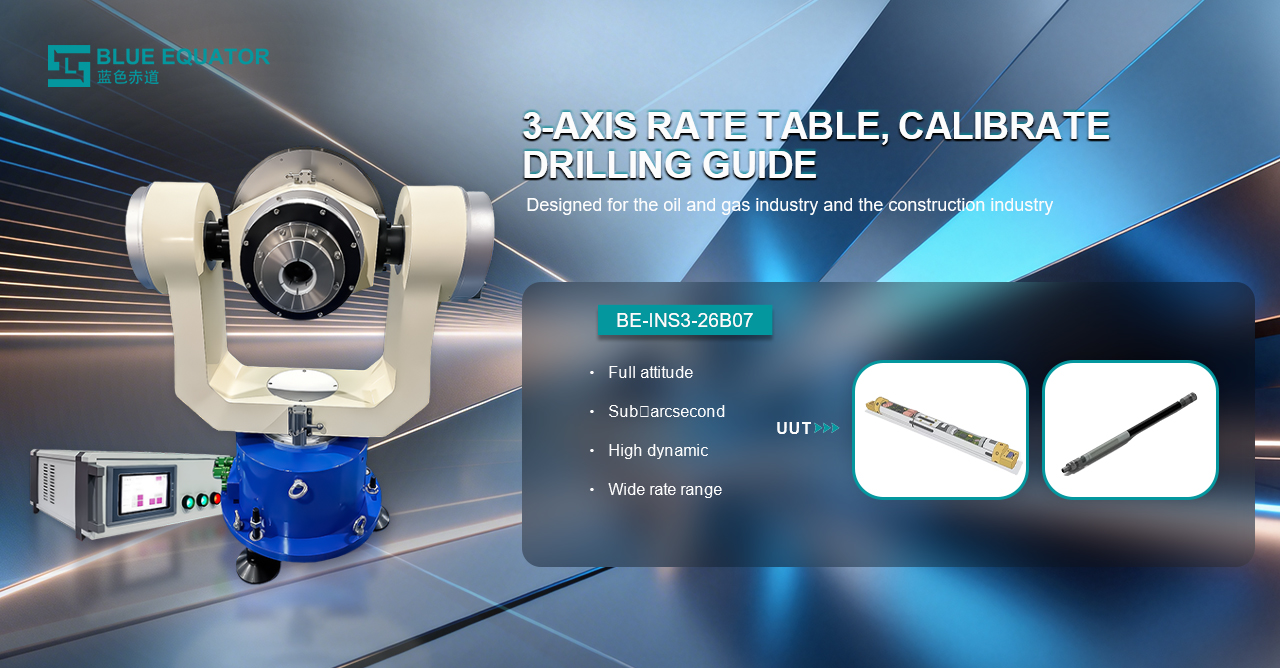
In drilling sensor and guidance instrument testing, precision and reliability are critical to ensuring downhole tool performance. The BE-INS3-26B07 high precision three axis rate table from Blue Equator is specifically designed for borehole surveying and drilling guidance instruments in oil, gas, and construction sectors. Its key performance specifications include:
Parameter Specification
3-Axis Angular Position Accuracy ≤±5 arcsec
3-Axis Angular Position Repeatability ≤±3 arcsec
Angular Travel Range (Each Axis) 360° continuous rotation
Inner Frame Max Angular Rate ±500°/s
3-Axis Synchronized Rate ±100°/s
Inner Frame Max Angular Acceleration 300°/s²
Rate Accuracy (360° avg) 5×10⁻⁵
Rated Load Capacity 20kg
Slip Ring Channels 30 channels (14×3A + 16×2A shielded)
Communication Interface RS-232
IV. Key Features and Value
High Precision Three Axis Positioning System: All three axes provide ≤±5″ angular position accuracy and ≤±3″ repeatability, ensuring consistent angular alignment for each test and providing a reliable data foundation for drilling sensor calibration.
Full Angle Continuous Rotation: All three axes support 360° continuous rotation with unlimited motion range, enabling simulation of any downhole tool attitude under complex working conditions to meet full orientation testing requirements.
High Dynamic Response Capability: Wide rate adjustment range and high angular acceleration response (inner frame 300°/s²) adapt to various drilling scenario simulations, from low-speed precision positioning to high-speed dynamic testing.
Multi-Channel Slip Ring Integration: Built-in 30-channel slip rings (including shielded lines) support continuous signal and power transmission, ensuring stable data collection from drilling guidance instruments during long-duration rotation testing.
Intelligent Control Software: Equipped with computer automatic control and data acquisition processing system, supporting RS-232 communication for convenient remote operation and test data management.
V. Typical Applications
Drilling Survey Instruments: Full-attitude calibration and dynamic performance validation of borehole trajectory measurement equipment used in oil and gas exploration
Drilling Guidance Tools: Simulating downhole rotation and tilting motion to test control accuracy and response characteristics of guidance tools
Drilling Sensors: Performance evaluation of inertial devices including gyroscopes, accelerometers, and magnetometers under high-speed and high-acceleration conditions
Measurement While Drilling Systems: Validating data acquisition accuracy and signal transmission stability of MWD tools during continuous rotation operation
Construction Industry Inertial Measurement Equipment: Sensor calibration and reliability testing for foundation inspection, tunnel guidance, and pipeline laying projects