The global directional drilling services market continues to expand in 2026, with Rotary Steerable Systems (RSS) and Measurement While Drilling (MWD) technologies accelerating their evolution, placing higher demands on downhole sensor testing accuracy.
I. Industry Background: Steady Growth in Oil and Gas Drilling Market
Global oil and gas drilling activity remains robust in 2026. The directional drilling services market is projected to grow from 14.97 billion USD in 2026 to 25.07 billion USD by 2034, at a CAGR of 6.65%. The Rotary Steerable Systems (RSS) market is also showing steady growth, valued at 5.08 billion USD in 2025 and expected to reach 9.9 billion USD by 2035. The Measurement While Drilling (MWD) market is developing rapidly, projected to grow from 3.84 billion USD in 2025 to 4.17 billion USD in 2026, at a CAGR of 8.6%.
II. Four Key Technology Trends in Drilling for 2026
1. Directional Drilling Precision Continues to Improve, RSS Technology Accelerates Adoption
In 2026, Rotary Steerable Systems (RSS), as the core technology of directional drilling, continue to see growing market demand. Operators' pursuit of faster drilling speeds and smoother, less tortuous wellbores has driven the widespread adoption of RSS technology. Industry data shows that global RSS sales reached approximately 3.0 billion RMB in 2025, with 4.0 billion RMB expected by 2032.
2. High-Temperature MEMS Sensor Technology Achieves Breakthroughs
Downhole extreme environments impose significant challenges on sensor high-temperature tolerance. Sensors must work continuously and accurately for extended durations in extremely harsh underground conditions. MEMS IMUs such as the ER-MIMU-09C feature significantly expanded operating temperature ranges and can perform dynamic north-finding in magnetically disturbed environments, accurately sensing tool attitude during drilling operations. TDK has also launched high-temperature MEMS accelerometers for drilling applications up to 175 degrees Celsius.
3. Intelligent Steering Technology Completes Overseas Testing, Driving Testing Equipment Upgrades
The Chinese Academy of Sciences' intelligent steering technology successfully completed overseas testing in the Middle East. The AziRes LWD tool can accurately identify formations based on rock electromagnetic properties, providing scientific basis for dynamic wellbore trajectory optimization. China's first intelligent drilling and completion experimental platform for deep unconventional oil and gas can simulate extreme downhole conditions including 4000m well depth, 150 degrees Celsius high temperature, and 70MPa high pressure. Meanwhile, national standard GB/T 46212-2025 "Petroleum Drilling and Production Equipment - Electromagnetic Telemetry Measurement While Drilling System" officially came into effect on March 1, 2026, specifying technical requirements and test methods for electromagnetic telemetry MWD systems.
4. Unconventional Oil and Gas Development and the Growing Importance of Downhole Measurement
PetroChina announced annual shale oil production exceeding 7 million tons, marking a new phase of large-scale, cost-effective development for continental shale oil in China. In the large-scale development of these unconventional resources, precise downhole measurement has become the key to ensuring geological "sweet spot" hit rates and reducing overall costs.
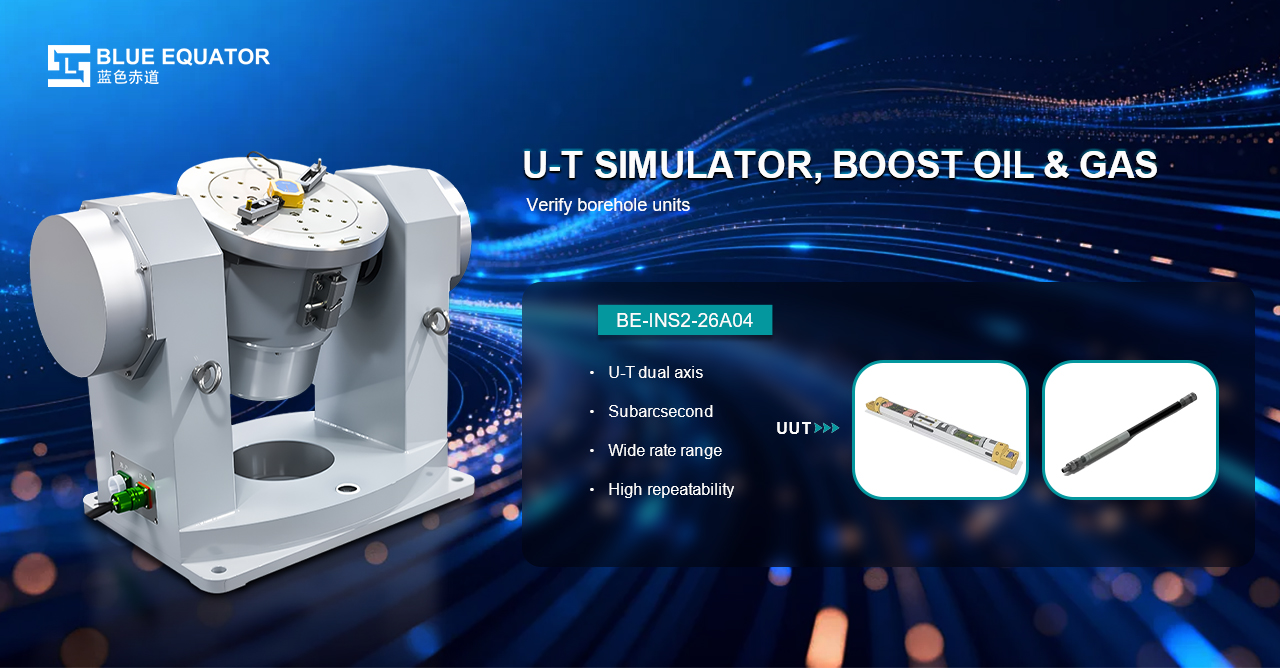
III. Product Solution: BE-INS2-26A04 High Precision Dual Axis Rate Position Table
In the field of drilling sensor and guidance instrument testing, precision and reliability are critical to ensuring downhole tool performance. The BE-INS2-26A04 high precision dual axis rate position table from Blue Equator is specifically designed for borehole surveying and drilling guidance instruments in oil, gas and construction sectors:
Mechanical Structure and Performance Specifications
U-T High Rigidity Structure: U-shaped outer frame for horizontal axis motion, T-shaped inner frame for vertical axis motion, both axes providing excellent rigidity and deformation resistance.
Dual Axis Continuous Unlimited Rotation: Both inner and outer axes support 360 degrees continuous rotation, enabling simulation of any downhole tool attitude.
Dual-Axis Angular Positioning Accuracy: +/-3 arcsec, repeatability +/-2 arcsec.
Tilt Accuracy: Inner frame +/-3 arcsec, outer frame +/-3 arcsec.
Rate Range: Both axes from 0.001 deg/s to 300 deg/s, covering low-speed precision positioning to high-speed dynamic testing.
Rate Stability and Slip Ring Configuration
Rate Accuracy: At high speeds (>=10 deg/s): 3 x 10^-5 (360 deg average); medium speeds (1-10 deg/s): 3 x 10^-4 (10 deg average); low speeds (<1 deg/s): 3 x 10^-3 (1 deg average).