In cluster drilling and infill wells, a 1-arcsec uncertainty may trigger collision risks. BE-INS3-26A09 delivers ±20″ repeatability and full-temp calibration, providing a traceable metrological reference for MWD attitude to safeguard well spacing integrity.
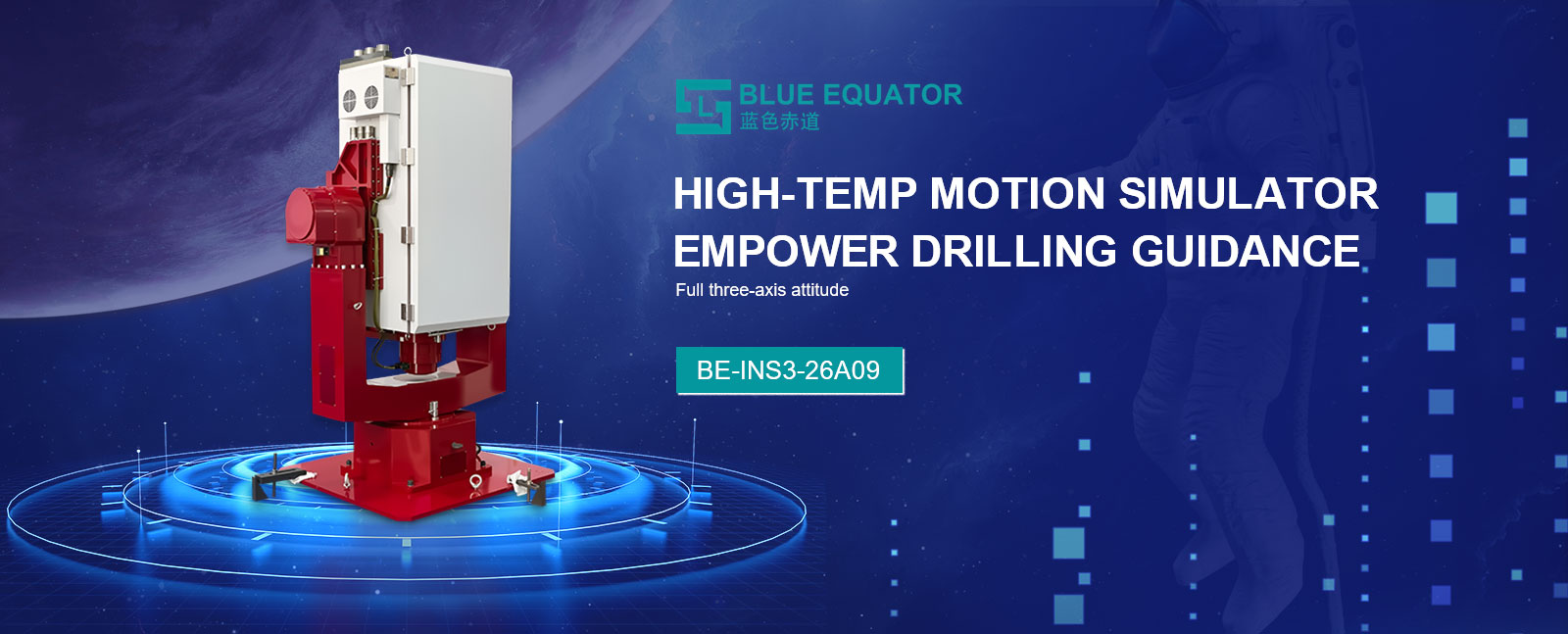
【wuhan, July 23, 2026】—— As offshore platform cluster wells, mature-field infill drilling, and ultra-deep well sections become the new normal, the spatial clearance between adjacent wellbores has tightened from meter-level margins to sub-meter or even centimeter-scale risk zones. Wellbore collision is no longer a theoretical concern but a recurring operational hazard. Against this backdrop, we reaffirm the core value proposition of the BE-INS3-26A09 Triaxial Thermal Test Stand — to deliver a fully traceable reference baseline for downhole attitude sensors, fundamentally reducing measurement uncertainty that erodes confidence in wellbore position awareness."
Calibration Uncertainty as a Safety Factor
In the MWD measurement chain, temperature-induced shifts in accelerometer and magnetometer bias, scale factor, and inter-axis non-orthogonality constitute the primary contributors to trajectory computation errors. Yet many field operations rely solely on factory certificates or simplified single-point corrections, overlooking the actual performance deviation of sensors under 200°C downhole conditions. With independently driven triaxial frames and a full-range programmable thermal chamber, the BE-INS3-26A09 replicates arbitrary combinations of inclination and azimuth at ±20 arc-second position repeatability, enabling end-to-end system-level verification from ambient to 200°C — far beyond component-level testing. Every surveyed trajectory post-calibration carries a quantified total uncertainty budget, delivering hard boundaries for anti-collision decision-making.
Long-Term Repeatability for Time-Dependent Risk Control
During extended-reach drilling campaigns lasting weeks or months, sensor performance degradation is rarely linear or predictable. This system emphasizes not just single-run accuracy but measurement repeatability across cycles, temperature zones, and rate regimes — combining 7.2 arc-second position resolution and 0.02°/s rate resolution to capture subtle drift trends across multiple calibration runs. This capability enables operators to build a metrological history file for each downhole tool, identifying early signs of magnetometer thermal hysteresis or gyro rate-dependent deterioration before they escalate into downhole survey failures, shifting from reactive troubleshooting to proactive warning and significantly reducing non-productive time (NPT).
Integrated Calibration Solutions for Multi-Well Platforms
For offshore platforms or desert fields with multiple wellheads operating simultaneously, the BE-INS3-26A09's φ240mm×700mm payload envelope and 150kg capacity accommodate MWD pulsers, electronic subs, and rotary steerable tools of varying sizes without custom fixturing — dramatically streamlining logistics and on-site calibration overhead. Its stable magnetic-field control (≤3 Gs) ensures that magnetometer calibrations remain comparable across well sites even in electromagnetically congested multi-well environments, enabling collision scans and trajectory optimizations on a unified reference frame.
Building an Auditable Metrological Chain for Global Drilling Operators
As ISO 17025 accreditation and API Q2 quality management become de facto entry criteria for international oilfield services, the traceability and documentation integrity of calibration activities are paramount. The BE-INS3-26A09's automated test sequences support full-data logging and report generation, satisfying third-party audits' stringent requirements for raw data, environmental conditions, and procedural records. We are committed to providing global drilling contractors, independent E&P companies, and borehole survey providers with a calibration infrastructure that balances engineering practicality with regulatory rigor — ensuring every degree of inclination and every minute of azimuth withstands dual scrutiny of safety and efficienc